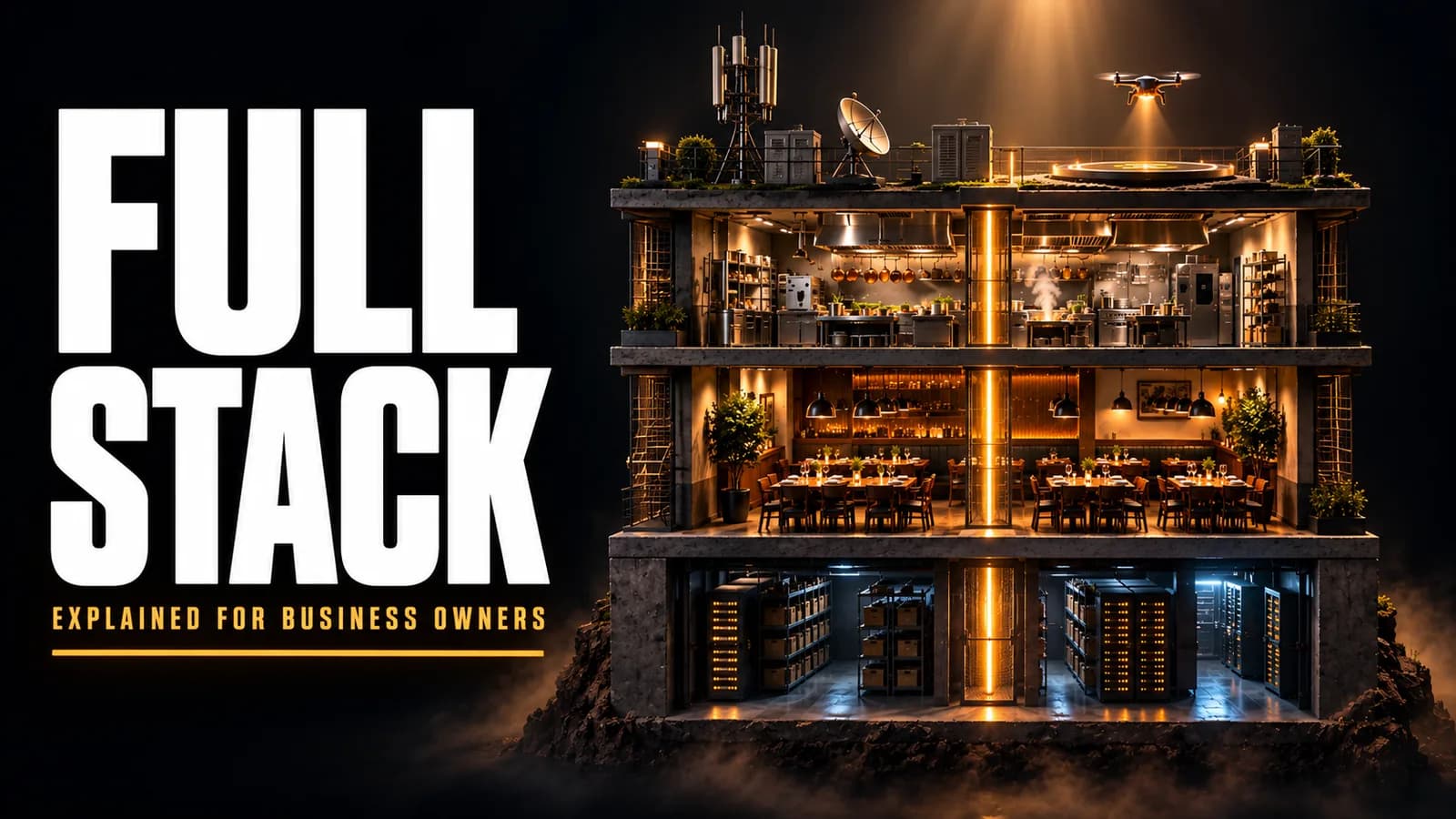
You asked three developers for a quote. Two of them wrote “full stack application” on it. Neither explained what it means, and one spelled it differently in two places.
Here is what the term actually covers. It is not a product and it is not a price band. It describes everything a piece of software touches, and once you can see the layers, quotes stop being three private languages and start being comparable.
The four layers, in plain words
A full stack application is software where one team builds across all of these layers:
- What people see (the frontend): the pages, buttons, and forms in a browser or on a phone. The dining room of the restaurant.
- What does the work (the backend): the part customers never see. It takes a submitted order, checks it, and acts on it. The kitchen.
- Where the data lives (the database): orders, customers, invoices. The storeroom, with a log of who took what and when.
- How it reaches the world (deployment): the servers, the releases, the backups. How the food actually gets to the table while it is hot.
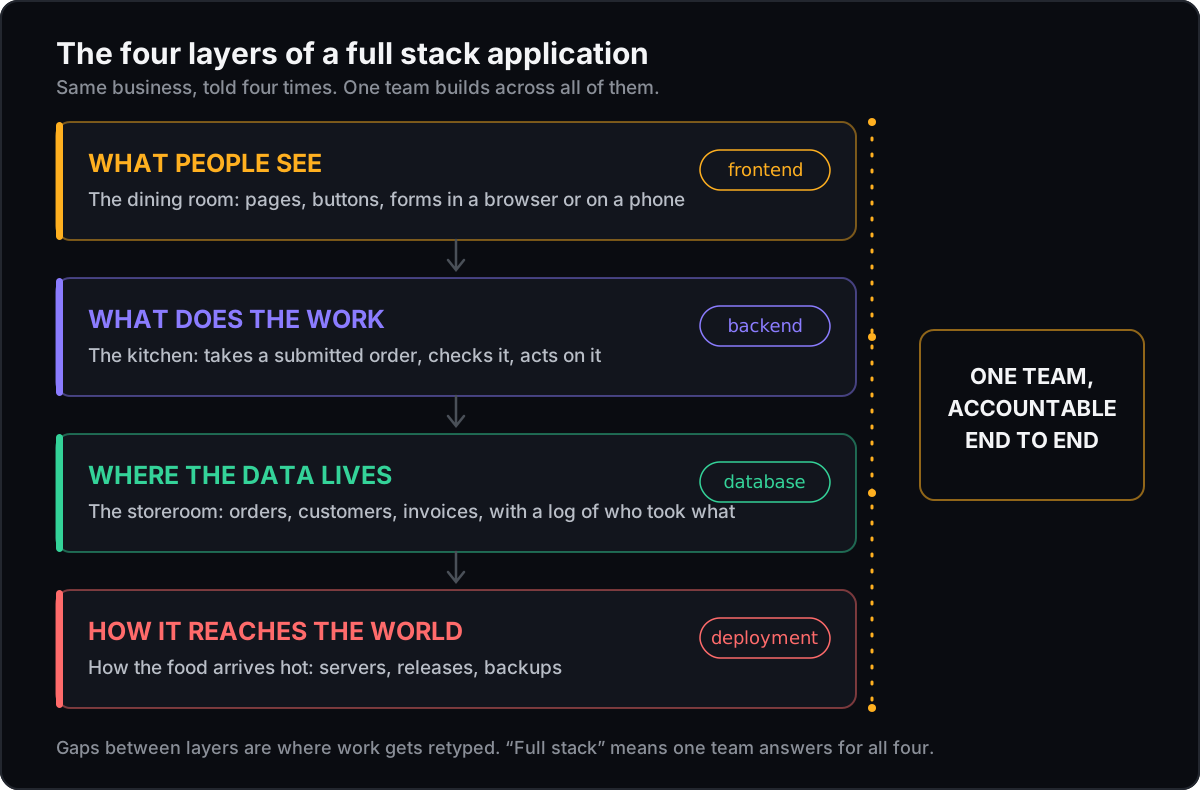
“Full stack” means one team is accountable for all four. When the person who built the button is not the person who manages the storeroom, gaps open between them. Gaps between systems are where work gets retyped.
What the 2026 numbers say
You do not need to take any developer’s word for what the standard stack is. It is measured, every year, in public.
GitHub’s Octoverse report found TypeScript overtook every other language on the platform in August 2025, growing 66% in a year (GitHub, Octoverse 2025). TypeScript is JavaScript with a type contract written into it: mistakes in how data is handled get caught by a machine check instead of by your customers.
The Stack Overflow survey (49,000 developers, 2025) measured what they use: Node.js, the JavaScript runtime that runs outside the browser, at 48.7%. React, the library behind a large share of the interfaces you touch, at 44.7%. Next.js, the framework that builds on React, at 20.8% (Stack Overflow Developer Survey 2025).
The stack also moves on a schedule you can plan around, which matters when you are signing anything multi-year. Next.js 16 shipped in October 2025 with a rewritten compiler that cut build times several-fold and support for the newest React release (nextjs.org). The names stay the same; the versions roll; the team that tracks them is showing you a habit, and the habit is what you are buying.
The boring stack won. Next.js, React, TypeScript, Node. That is good news for a buyer, for one reason: hireable. The most-used tools have the largest hiring pools, the longest documentation trails, and the most people who can take over when the original developer moves on. Choosing them is not fashion. It is exit planning.
Three questions that test a quote
Any developer who works on this stack daily answers these in one sentence each. Ask them:
- “Which versions do you build on, and which ones still get security updates?” Node.js publishes a support schedule; the current long-term support release is version 24 (nodejs.org). “We use the latest” is not an answer. A version number is.
- “What runs before code ships?” The automated checks (the machine-run tests that gate every release) have names. A team that has them names them in seconds.
- “Who owns the repository from day one?” The repository is where your code lives. If the answer contains the word “eventually”, that is your exit price being decided in advance.
What this does not mean
None of this says every business needs a custom application. A standard online store, or a brochure site that exists to be found, is served well by a template at a fraction of the price. Custom earns its price where the workflow is yours: the intake, the quoting, the dispatch, the follow-up chain that no off-the-shelf tool matches, because nobody else works the way you work.
The point of knowing the stack is narrower and more useful. You can hear the difference between a developer who builds on it daily and one quoting it because the word sells.
We build on this stack daily. Our own site runs on it, and its source code is public, so you can read how it is put together (github.com/Anito-Systems-Solution/anito-main-web). If you are weighing quotes and want a straight answer about what the words on them mean, discuss your project with us. You will get a plain reply about what we would do, what it depends on, and whether you need us at all.
Common questions
Is “full stack” the same as “full service”?
No. Full stack describes the technical layers one team builds across: interface, logic, data, deployment. Full service is a business claim about everything around the build, like design, copy, and support. Ask which layers the team personally builds and which they subcontract. Both models work, but the quote should say which one you are buying.
Do I need a full stack application if I only need a website?
Often no. A site whose job is to be found and to look right is served well by a template or a lean build, and it costs less. The full stack enters when the site has to do work: take orders, check stock, talk to your invoicing, hand tasks to staff. Name the work first; the stack follows from it.
Which stack should I ask for by name?
Ask for names, then ask why. Next.js, React, TypeScript, and Node form the most measured, most hireable combination in 2026, and they are a sound default for custom web work. What matters more is that the developer can say why those fit your job, and what they would use instead if something fit better. A developer with no “instead” is reading from a menu.
Our current system is older technology. Does that change the answer?
It changes the conversation, not the questions. Older systems raise the cost of the move and the value of an exit plan. Ask any quoting developer how they would run the old and new systems side by side during the change, and what happens to your history. Those answers are worth more than the framework name.