
A developer leaves. Six months later someone asks for “the same report but with a totals row.” The change touches a field name, and that field name appears in eleven places nobody remembers. The old developer is gone, the list of places lives in their head, and your small change starts with an archaeology project.
TypeScript exists to delete that archaeology. It became the most-used language on GitHub in August 2025, ahead of JavaScript and Python, growing 66% in a year (GitHub, Octoverse 2025). Here is what that actually buys a business owner, in plain words.
A type contract, explained without jargon
TypeScript is JavaScript with a written contract on every piece of data: this field is a date, that one is money, this one must exist, that one is optional. Before the code runs, a compiler (a machine checker, not a person) reads the contract and the code together and lists every place they disagree.
Rename a field under a type contract and the compiler prints every file that mentions it. All of them. In seconds. Nobody has to remember anything, because the list is not in a head, it is in the build.
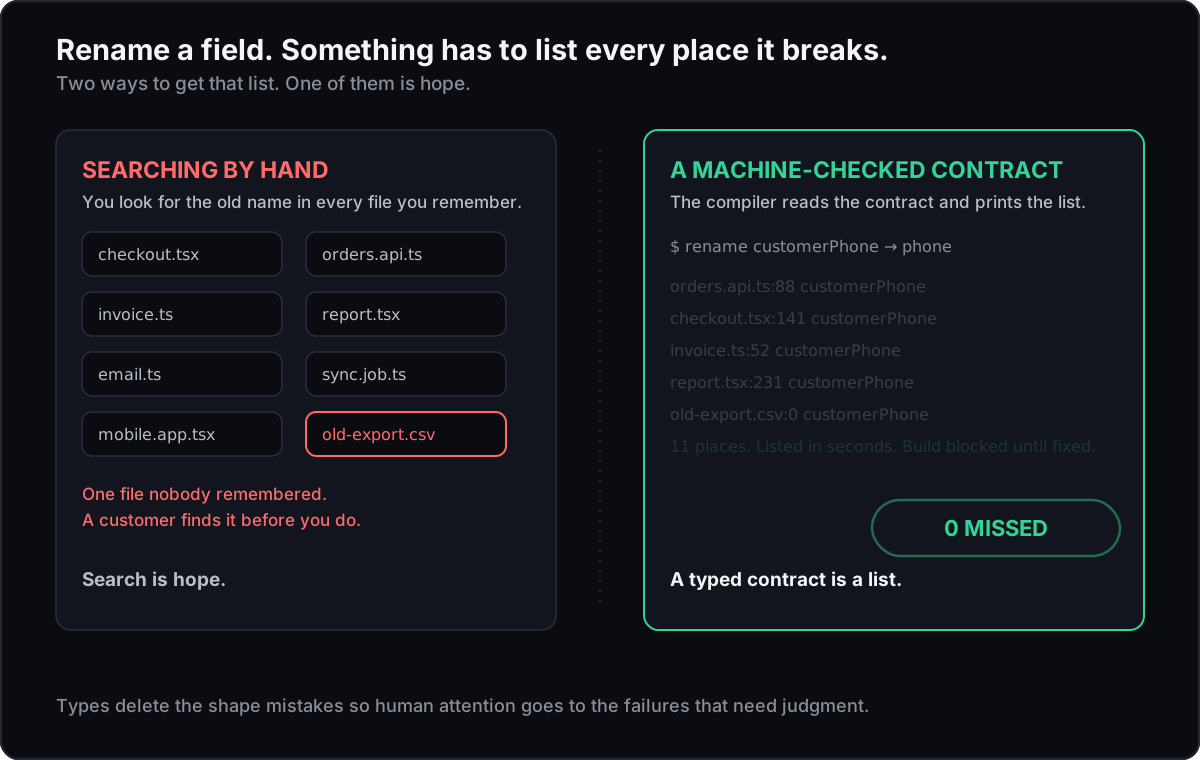
Search is hope. A typed contract is a list. Untyped code lets a bad rename sail through until a customer finds it, because nothing forces the eleventh place to admit it exists. The contract turns “I think we got them all” into a machine-checked sentence.
The experiment we run on ourselves
We apply the same idea past the code. Our site’s source (public: github.com/Anito-Systems-Solution/anito-main-web) carries machine checks that most sites do not bother with: a test that fails the build if rendered copy uses British spellings (the brand is US English by rule), and a test that fails if banned or previously fabricated names ever appear in copy again. The rules are the owner’s; the enforcement is the machine’s.
That is the whole philosophy in one build: any rule a person has to remember will be forgotten on a Friday. A rule the machine checks survives every Friday. The type contract is that philosophy applied to your data, which is the part of the system your money actually flows through.
Why the trend matters to your quote
Stack Overflow’s 2025 survey (49,000 developers) measured TypeScript at 48.8% among professional developers. Nearly half the professional world can read it. That number is your hiring pool, your replacement options, and your exit plan, all measured instead of promised.
It also changes what your maintenance costs. A change that a compiler checks cannot half-land: either the build passes or it lists what is broken. Fewer surprises in production means fewer emergency invoices, and the invoices that do come are for new work, not for rediscovering what the last developer already knew.
What typed does not mean
An honest limit, before anyone sells types as a guarantee: the contract proves the data has the right shape. It does not prove the business rule is correct. A field can hold a perfectly formatted number that is still the wrong number, which is why typed code still needs the tests and the outside QA pass described elsewhere in this series. Types delete one class of failure (shape mistakes, the renamed field, the missing value) so the human attention left over goes to the failures that need judgment. That is the trade, stated plainly: machine checks for shapes, human checks for meaning, and neither pretends to do the other’s job.
What to ask
Put this to any developer you are quoting with, us included:
- “Is the code typed? If a field name changes, what tells you every place that breaks?” The answer you want is one word: the compiler. The answer you do not want is a person’s name.
- “What machine checks run before code ships?” Typed or not, every build should have a list, and the developer should be able to name it without opening a laptop.
- “Could another team take this over in a year?” Typed contracts are the cheapest handover insurance that exists, because the code documents itself at the exact spots where handovers go wrong.
A template or a no-code tool for a standard store needs none of this, and if that is your job, buy the tool. The contract matters when the software carries your specific workflow, the one nobody else has. If you are weighing which side of that line your project sits on, discuss your project with us, or read our guide on the build versus buy decision. The answer sometimes is “do not hire anyone,” and we will say so.
Common questions
Is TypeScript a different language my team cannot hire for?
It is JavaScript with contracts added, so any JavaScript developer already speaks most of it, and Stack Overflow’s 2025 survey measured it at 48.8% usage among professional developers. It is now the most-used language on GitHub. The hiring pool is large and growing, which is exactly why it lowers your risk instead of raising it.
Does the type contract slow development down?
It moves time from production surprises to writing time, which is the cheaper place to spend it. Writing contracts adds a margin to the first weeks. It repays on the first change that touches shared data, and on every handover after that, because the compiler catches the breakage class that otherwise reaches customers. For a small brochure site the margin may not repay; for a system carrying your workflow it does, quickly.
Can I add TypeScript to existing code later?
Yes, in slices: newest and riskiest code first, oldest code as it gets touched anyway. A full retrofit of a large old system is a project with a real price, and it is fair to ask any developer proposing one for the slices-first plan and the exclusions. If nobody proposes slices, ask why not.
What does this have to do with AI-generated code?
A contract is also the cheapest safety net for machine-written code. AI assistants produce code fast and confidently, and the compiler checks every line of it against the contract before it ships, the same as it does for human-written lines. Typed code plus automated checks is how teams get the speed without inheriting the errors.